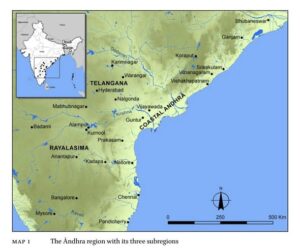
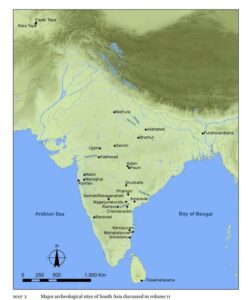
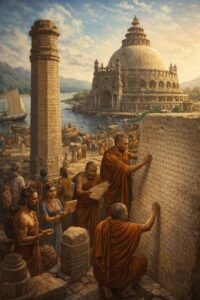
The history of Buddhism in Andhra (ancient Andhradesa) survives not in manuscripts but in stone inscriptions, relic deposits, pillars, and copper plates. Unlike regions where literary traditions endured, the Buddhist past of Andhra is preserved overwhelmingly through epigraphy and archaeology. From roughly the 2nd century BCE to the 4th century CE, the Krishna–Godavari region witnessed one of the most vibrant Buddhist cultures in the Indian subcontinent. The epigraphic corpus shows that the vast majority of early inscriptions relate to Buddhist patronage, making Andhra one of the richest regions for reconstructing Buddhist history.
The Rise of Buddhist Culture in the Krishna Valley
From the late centuries BCE, the Krishna river valley experienced growth in trade routes, emergence of urban centres, expansion of regional polities, and increased religious patronage. Sites such as Amaravati and Nagarjunakonda became major Buddhist centres. After the collapse of the Mauryan Empire, local political formations emerged, and expanding trade networks helped intensify religious donations and monastic construction.
Political Dynasties and Buddhist Patronage
Early inscriptions, including relic deposits at Bhattiprolu, show that local rulers supported Buddhist institutions. The Sada dynasty controlled parts of the Krishna–Godavari delta and patronized Buddhist establishments during a period of prosperity linked to trade.
The Satavahanas ruled large parts of the Deccan from the 1st century BCE onward. However, archaeological and epigraphic evidence suggests that Amaravati’s growth began before their conquest. Few royal inscriptions of Satavahana kings are found at Amaravati, indicating that Buddhist expansion was not solely a royal project but also supported by merchants, guilds, and lay donors.
In the 3rd and 4th centuries CE, the Ikṣvākus established their capital at Vijayapuri (Nagarjunakonda) and became major patrons of Buddhism. Inscriptions show the construction of stupas and monasteries, the prominent role of royal women as donors, and the use of religious patronage to reinforce political authority.
Buddhist Sites as Epigraphic Archives
Amaravati stands as one of the earliest and largest Buddhist stupas, with hundreds of inscriptions recording donations from monks, nuns, merchants, guilds, and lay followers.
Nagarjunakonda, the Ikṣvāku capital, preserves inscriptions documenting monastic foundations, royal patronage, and connections between religion and power.
Numerous other sites across Andhra confirm the widespread presence of Buddhism, including Bhattiprolu, Ghantasala, Salihundam, Chandavaram, Guntupalli, and Phanigiri.
Donors and Social Composition
The inscriptions reveal that Buddhism in Andhra was supported by a broad social base. Donors included merchants, artisans, guild members, women patrons, monks and nuns, and local chiefs. This wide participation indicates that Buddhism functioned as a socially inclusive religious movement.
Andhra as a Buddhist Network Hub
Archaeological and epigraphic evidence indicates connections between Andhra and Sri Lanka, the Tamil country, Karnataka, and the wider Buddhist world. The Krishna valley served as a nodal point linking inland trade routes with maritime networks, enabling the movement of monks, ideas, and artistic traditions.
Andhra-Buddhism
Language, Script, and Cultural Transition
Early inscriptions are written in Prakrit (Middle Indo-Aryan) using the Brahmi script. In the later period, especially after the Ikṣvākus, Sanskrit began to replace Prakrit. Copper-plate land grants and new administrative practices emerged, reflecting shifts in political and religious patronage. These changes mark broader transformations in the religious landscape.
Decline and Transformation
After the 4th century CE, patterns of patronage shifted. Brahmanical institutions increasingly received land grants, Sanskrit became the dominant language of inscriptions, and Buddhism gradually declined in prominence, although it continued in certain areas for centuries. New dynasties such as the Pallavas, Salankayanas, and Vishnukundins reshaped religious patronage and cultural priorities.
Distinctive Features of Andhra Buddhism
Andhra’s Buddhist culture shows several distinctive characteristics: monumental stupa architecture, strong mercantile and lay patronage, significant participation of royal women donors, integration with maritime trade networks, links with Sri Lankan monastic traditions, and preservation primarily through inscriptions rather than literary texts.
Conclusion
The inscriptions of Andhra transform stone into history. They reveal a Buddhist landscape animated by merchants, queens, monks, and artisans; connected to trade and transregional networks; and shaped by evolving political power. From Amaravati’s sculptured railings to Nagarjunakonda’s royal dedications, the epigraphic record demonstrates that Andhra was a major centre of early Indian Buddhism.
Even when literary traditions disappeared, the memory of Buddhism endured in carved pillars and relic caskets. Through these inscriptions, Andhra continues to speak as one of the most vibrant Buddhist regions of ancient India.
Reference
Early Andhradesa: Historical Studies around the Epigraphic Corpus. Volume 1: Introduction and Inventory
By Vincent Tournier