
Location:
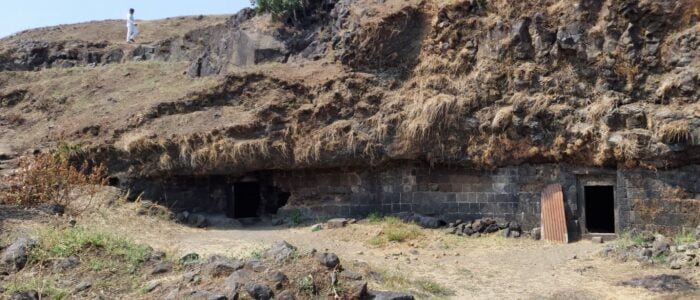
Lohagadwadi caves situated in Lohagad Fort hill, District Pune, Maharashtra, India
Historical Importance:
In ancient times, you can see the dominance of Satvahana emperors in Maharashtra. It is mentioned that Venudutta, the son of Kosikiputra, donated water tanks during the reign of Vashishtiputra Pulumavi on the nearby Visapur fort.
It is understood that this Kosiki son Venhudatta was working as a Maharathi of Vashishtiputra Pulumavi. It is also mentioned in the Bhaje Caves. In the Karla Buddha Caves, the inscription of Vashishtiputra Pulumavi is found, while in the Karla Buddha Caves, the inscription of Gautamiputra Satkarni is also found.
The period of Satvahana is a total period of 460 years from 230 BC to 230 AD. In this, 30 emperors of Satavahana have ruled. A new history of Maharashtra comes to light through inscriptions from the administration of Satvahan. It is clear that the spread of Buddhism in the Maval region during the Satavahana period was very large.
Today Maval is divided into three parts. In Andar Maval, Nane Maval, and Pawan Maval you will find groups of more than 30 caves.
The Satvahana emperors built caves in Maharashtra to provide a facility for Buddhist monks to propagate and spread the Buddhist Dhamma. Later, as the caves were used for trade routes, they were also used for the accommodation of traders.
Cave Architecture:
There are seven to eight cave clusters at Lohagad hill, the most important of which is at the very top of the Lohagad ticket window where you get to see the inscription. The caves at the beginning are completely ruined. It was used in the 17th century AD.
The water tanks here are clearly working to supply water to the people of the fort. At the very top of Lohagad fort, you can see the remains of some caves and the remains of a water tank. The largest cave in the fort is named after Lakshmi Kothi Jilla, which is actually a grand cave.
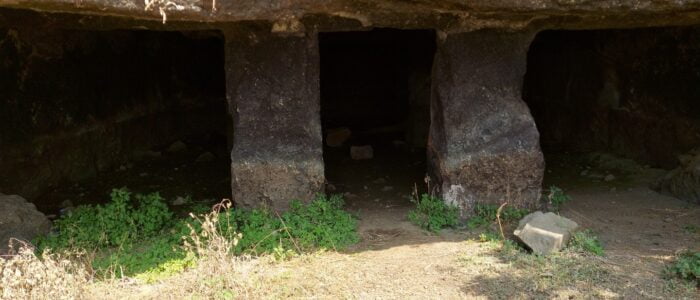
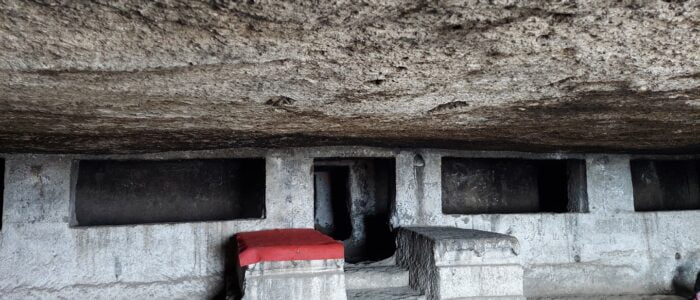
The first two caves are small caves with verandah, halls, cells, and benches, and the other five caves having cell, recess, large water cisterns. All these caves are located at different levels like the lower, middle, and upper caves.
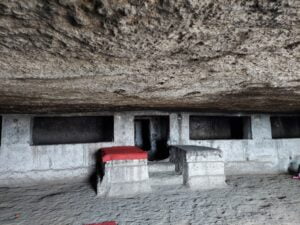
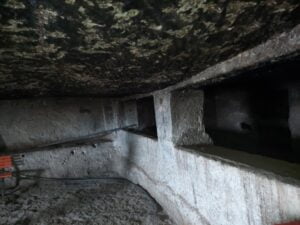
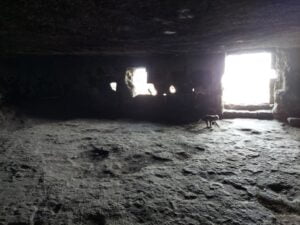
Cave No. 1
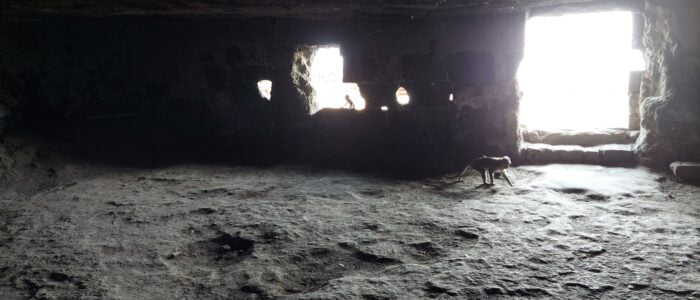
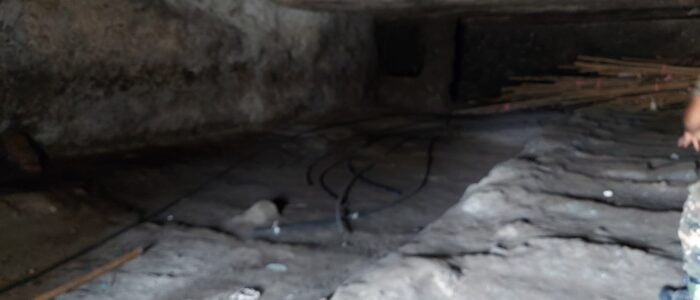
This cave consists of halls and cells (with a large hall). The halls are divided into parts by wall. The cells having benches or asana. It has a single doorway and opens to its front hall. The water cistern-like excavation is attached to the cave.
Cave No. 2
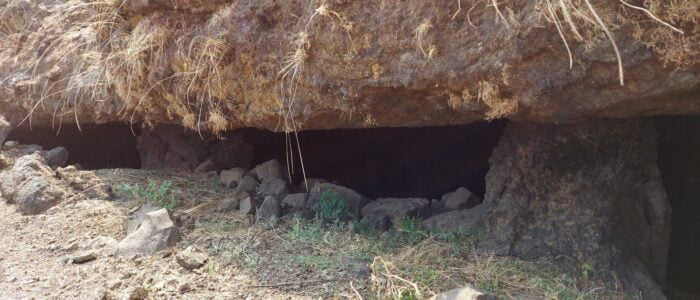
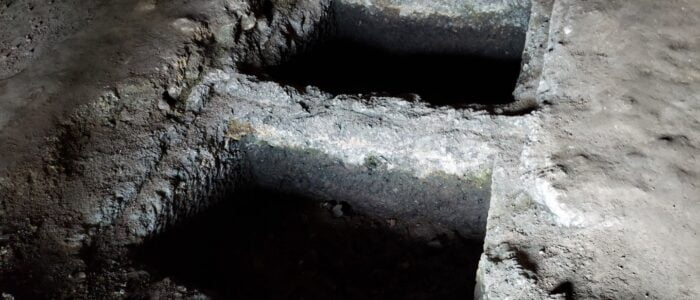
This cave is situated above cave no. 1, it is an unfinished cave and partially lost due to erosion. This is cell-like cave measures about 2 meters wide with 1.5 meters in height and 2 meters deep in the rock. The inner back wall of this excavation has a small carved niche, with a step-like projection in front of it.
Cave No. 3
This cave is situated next to cave 2. This cave having an upper and lower cell, the upper one has a rectangular opening. It having a carved stairway to access the cave which is partly broken and missing.
Cave No. 4
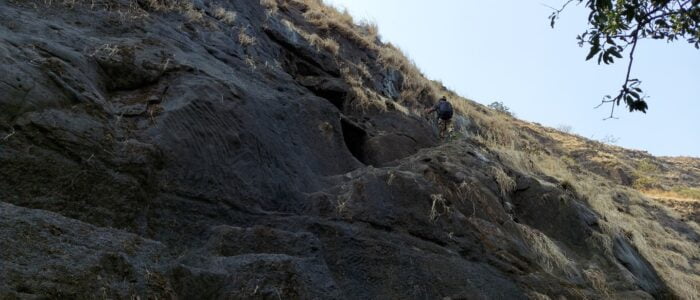
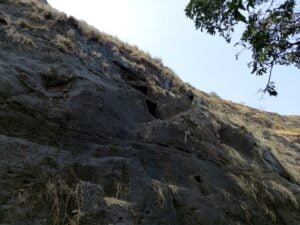
This cave is situated on the uppermost level of the southern corner of the fort in the cliff. The cave has a front hall, inner hall, and two cells, and a small water cistern. The cave had a carved stairway, leading to the front hall of the main cave from its southern side. It seems that the cave was well connected with other excavations by stone-carved stairways. But today the stairways are badly ruined and have become very difficult to reach.
Cave No. 5
This one is a small, unfinished cave that has niches and a recess.
Cave No. 6
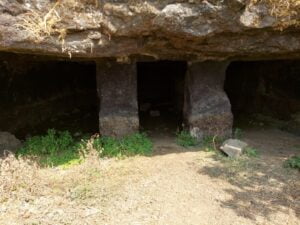
This cave has a narrow entrance with large water cistern may be used for storage purpose. This cave has carved pillars.
Cave No. 7
This cave is present at the middle level, high from the ground level.
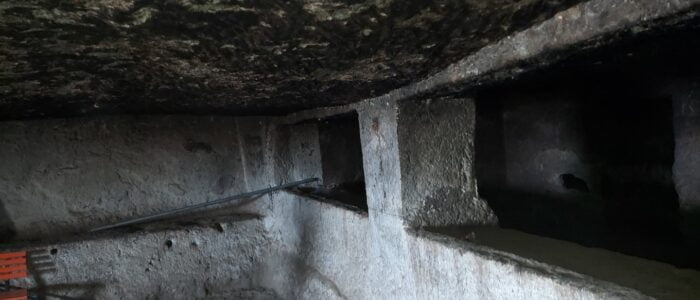
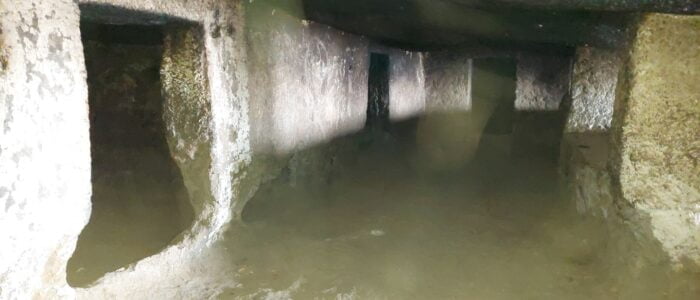
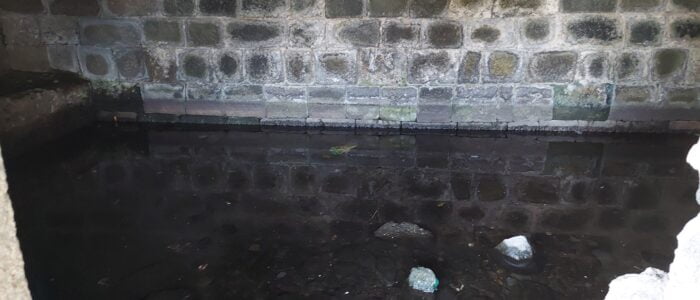
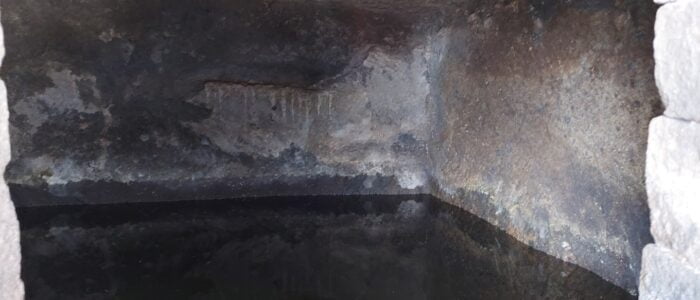
Inside this cave has a large water cistern of size 9M X 4M and 1M deep.
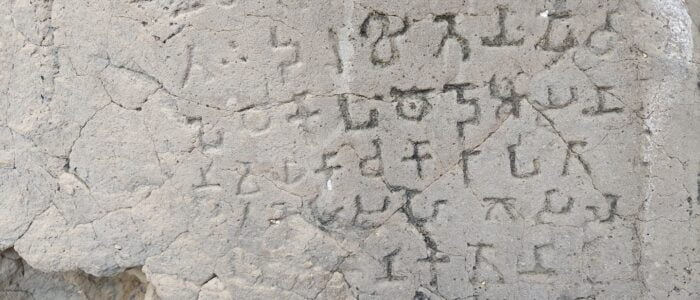
Later this cistern was converted into a chamber. A clear inscription is carved at the entrance of this cave.
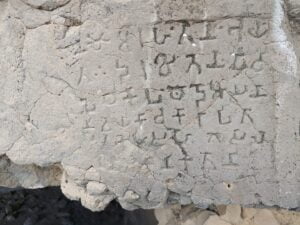
This can be read as –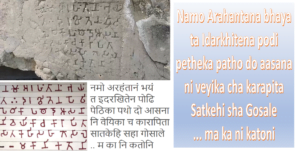
Means –
By bowing to the Arahantana Bhadant Indrarakshit has worked with Gosale to build a water cistern, railing, road, and two benches.
In Marathi-
अरहंताना नमन करून भदंत इंद्ररक्षित यांनी गोसाले यांच्या सोबत पाण्याचे टाके, वेदिका पट्टी, रस्ता व दोन आसान पेडिका यांचे निर्माण करण्याचे काम केलेले आहे
In Hindi –
अरहंत को प्रणाम करके भदंत इंद्रारक्षित ने गोसाले के साथ एक पानी की टंकी, वेदिका पट्टी, सड़क और दो आसान बनाने का काम किया है।
The word Arhant in the inscription is a state of enlightenment in the Buddhist Dhamma, the inscriptions found on the bone stupa of a Buddhist monk found in the Nirvana Bhoomi at Kanheri mention several Arahantana words.
The word Bhayant in the inscription means Bhadant and it is a word used for a Buddhist monk. Many words can be clearly read in the inscription in the Buddhist cave. It is mentioned in many inscriptions at Kanheri, in the inscription on the pillar in Cave No. 3, you can see Bhadant mentions like Bhadant Gahala, Bhadant Achal, Bhadant Vijaymitra, Bhadant Dhammapala, etc.
The word Namo is also mentioned in the inscription in the cave at Naneghat and the word-formation is from the same period and this period is the period of the progress of Buddhist Dhamma in Maharashtra.
Transportation Information:
Nearest Airport : Mumbai or Pune Airport
Nearest Railway Station : Lonawada Railway Station
Nearest Bus Station : Lonawada Bus Stop
Map:

Committed to research & conservation of Buddhist monuments that have a historical heritage of India.
अप्रतिम माहिती दिल्याबद्दल आभार